
Insect Killer Machine Buying Guide: Features, Types and Benefits

Flying insects can quickly become a problem in homes, offices, restaurants, shops, warehouses and other commercial environments. Flies, moths and other unwanted insects can affect cleanliness, comfort and, in food-handling environments, overall hygiene practices. An insect killer machine provides a convenient way to attract and control certain flying insects without relying entirely on frequent chemical spraying.
The wider importance of insect and vector management is significant. According to the World Health Organization (WHO), vector-borne diseases account for more than17% of all infectious diseases and cause more than 700,000 deaths every year worldwide. While an insect killer machine should not be considered a medical disease-prevention device, the statistic highlights why effective insect management remains important in residential and commercial environments.
Choosing the right machine, however, requires more than selecting the first model available. Buyers should consider the coverage area, attraction technology, safety features, power consumption, cleaning requirements, installation location and expected frequency of use.
For businesses, selecting the right insect killer machine supplier is equally important. A reliable supplier can help you compare specifications, understand maintenance requirements and select a machine suited to the size and purpose of your premises.
This buying guide explains the major types, features and benefits so you can make a more informed purchasing decision.
What Is an Insect Killer Machine?
An insect killer machine is an electrical or adhesive-based device designed to attract and control flying insects. Depending on the technology used, insects may be attracted by UV-A light, LED light or other attraction mechanisms before being eliminated by an electric grid or captured on an adhesive glue board.
Most machines consist of an attraction source combined with a trapping or killing mechanism. For example, an electric model may use light to attract insects towards an electrically charged grid. Glue-board models instead draw insects towards an adhesive surface that traps them.
A flying insect killer machine is commonly used to help manage flies, moths and several other flying pests. Certain devices may also be marketed for mosquitoes, although effectiveness can vary significantly by technology and insect species.
In fact, CDC-published guidance states that conventional high-voltage ultraviolet "bug zappers" do not provide satisfactory control of adult mosquitoes. Therefore, if mosquitoes are your primary concern, choose technology specifically designed and tested for mosquito attraction rather than assuming every UV machine will provide the same results.
Why Use an Insect Killer Machine?
Flying insects can be irritating in a home and potentially more problematic in offices, restaurants, cafés, shops and commercial facilities where cleanliness and customer experience matter.
An insect killer machine can provide ongoing support as part of a broader pest-management strategy.
Some important reasons for using one include:
- Helps reduce the number of certain flying insects indoors
- Operates continuously when required
- Reduces dependence on repeated insecticide spraying
- Supports a cleaner and more comfortable environment
- Can be installed in residential and commercial spaces
- Requires relatively simple routine maintenance
- Available in different capacities for different room sizes
The best insect killer machine is not necessarily the most expensive or powerful model. The right choice is the machine that matches your insect problem, coverage requirement, operating environment and maintenance expectations.
For commercial facilities, it should also work alongside preventive measures such as good sanitation, waste management, closed doors where practical and the reduction of insect entry points.
Also Read : Complete List of Washroom Accessories for Commercial Spaces
Types of Insect Killer Machines
Different insect-control technologies work in different ways. Understanding the main options will make it easier to select a suitable model.
1. UV Electric Insect Killers
A UV electric insect killer uses ultraviolet or insect-attracting light to draw flying insects towards the device. Once the insect reaches the internal electrical grid, it is eliminated through electrical contact.
An electric insect killer machine is commonly chosen for places requiring continuous operation, including:
- Homes
- Shops
- Offices
- Reception areas
- Warehouses
- Selected commercial facilities
These machines are generally simple to operate and usually include a collection tray underneath the electrical grid.
When comparing electric models, check the rated coverage, lamp type, grid design, protective casing and cleaning accessibility.
For commercial environments, particularly those handling food, placement needs additional attention. The FDA Food Code states that insect electrocution or stunning devices should retain insects within the device and should not be located over food-preparation areas.
2. Glue Board Insect Killers
Glue-board machines attract insects using light but capture them on replaceable adhesive boards instead of using an electric grid.
These machines can be useful where quieter and more discreet operation is preferred.
Common applications include:
- Restaurants
- Cafés
- Hotels
- Offices
- Retail spaces
- Reception areas
- Food-service environments
Because insects remain attached to the glue board, cleaning primarily involves replacing the adhesive board according to usage and manufacturer instructions.
When purchasing one, check how easily replacement glue boards are available because they form part of the machine's ongoing operating cost.
3. LED Insect Killer Machines
LED-based insect killers use energy-efficient light sources designed to attract particular flying insects.
LED technology can provide advantages such as lower electricity consumption, longer light-source life and reduced replacement frequency compared with some traditional lamp technologies. Actual performance, however, depends on the LED wavelength, machine design and insects being targeted.
LED models can be considered for locations where the machine operates for extended periods and energy efficiency is an important purchasing factor.
4. Indoor and Commercial Insect Killers
Not every machine is built for the same environment.
Compact indoor models are generally intended for:
- Bedrooms
- Kitchens
- Small shops
- Cabins
- Offices
- Small enclosed areas
Commercial insect killers typically offer greater coverage and more durable construction for locations such as:
- Restaurants
- Hotels
- Manufacturing facilities
- Food-processing areas
- Warehouses
- Commercial kitchens
- Large retail premises
A commercial insect killer machine may also provide larger collection trays, higher-capacity attraction systems and construction suited to longer operating periods.
Key Features to Look for in an Insect Killer Machine
Buying based only on price can result in a machine that is either underpowered for the room or unnecessarily large for your actual requirements.
Consider the following factors before making a decision.
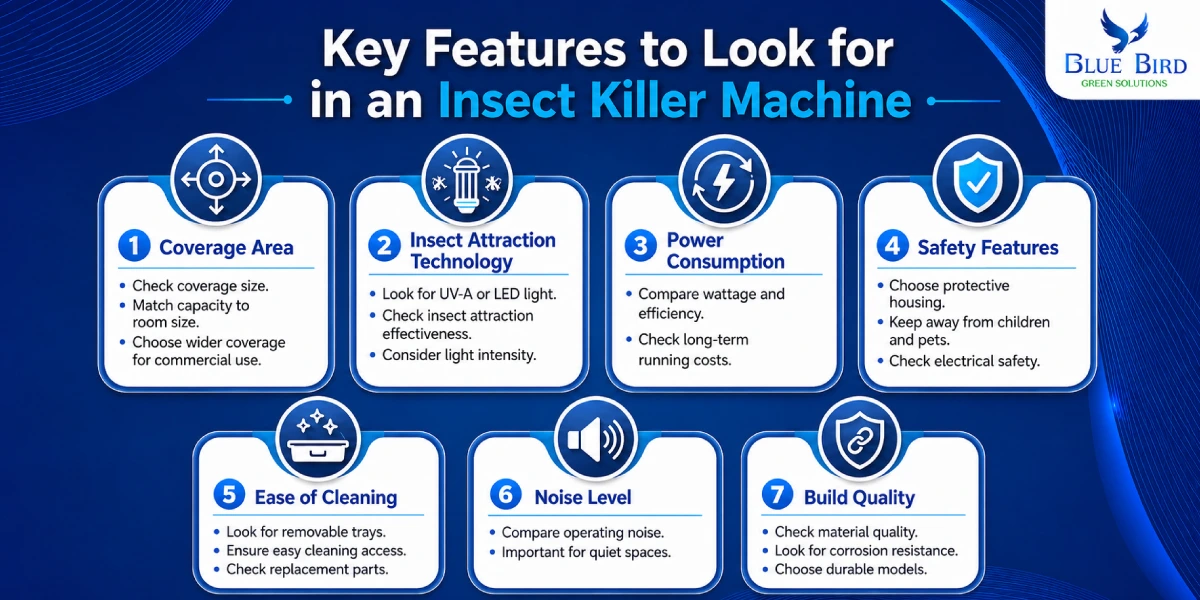
• Coverage Area
Start by checking the manufacturer's recommended coverage area.
A small machine designed for a compact room may not provide effective coverage across a large warehouse or restaurant. Similarly, installing an oversized machine in a very small room may be unnecessary.
Measure the intended area and compare it with the machine specification.
For large commercial spaces, several strategically positioned machines may sometimes be more practical than relying on a single unit.
• Insect Attraction Technology
Check what type of attraction technology the machine uses.
Common options include:
- UV-A lamps
- Specialised fluorescent lamps
- LED attraction systems
- Other insect-attracting technologies
Different insects respond differently to light, wavelengths, heat, carbon dioxide and other environmental signals. Therefore, look at the insects the manufacturer specifically states the device is designed to target.
If your primary concern is flies, select a machine specifically designed as a fly insect killer machine rather than assuming every insect-control product performs equally well against all pests.
• Power Consumption
Electricity consumption becomes important when machines operate for many hours every day.
Compare:
- Total wattage
- Number of lamps
- LED versus traditional lamp technology
- Recommended operating hours
- Expected lamp replacement intervals
For hotels, offices, warehouses and restaurants requiring continuous operation, an energy-efficient machine may reduce long-term operating expenses.
• Safety Features
Safety should always be a priority when purchasing an electrical insect killer.
Important features may include:
- Protective outer grill
- Properly enclosed electrical components
- Stable mounting system
- Durable power cable
- Collection tray
- Secure access to internal components
An electric insect killer machine should be installed according to the manufacturer's safety instructions and positioned where children, pets or unauthorised users cannot easily access internal electrical components.
• Ease of Cleaning and Maintenance
An insect killer needs regular cleaning to continue functioning effectively.
Look for practical features such as:
- Removable insect trays
- Easy-access glue boards
- Replaceable light sources
- Accessible internal surfaces
- Simple opening mechanisms
Complicated maintenance can lead to irregular cleaning, particularly in busy commercial environments.
Ask your supplier about replacement lamps, glue boards and other spare parts before purchasing.
• Noise Level
Noise may not matter in a warehouse, but it can become important in quiet or customer-facing environments.
For example, consider operating noise when installing machines in:
- Offices
- Restaurants
- Hotel areas
- Reception spaces
- Shops
- Residential rooms
Glue-board models are often considered where discreet operation is particularly important.
• Build Quality and Durability
Commercial environments may require machines capable of handling longer operating hours and frequent cleaning.
Evaluate:
- Outer housing material
- Electrical component quality
- Corrosion resistance
- Mounting quality
- Collection system
- Lamp protection
- Availability of spare parts
Choosing reliable equipment should be part of broader insect solutions rather than treating the device as a temporary purchase.
Benefits of Using an Insect Killer Machine
The practical benefits will depend on the machine type and environment, but a properly selected machine can provide several advantages.
• Continuous Insect-Control Support
Unlike occasional sprays, a machine can operate for extended periods and continuously capture or eliminate insects attracted to it.
• Reduced Reliance on Chemical Sprays
Mechanical or electrical insect-control systems can help reduce the frequency with which chemical sprays need to be used indoors.
• Cleaner Indoor Environment
Controlling visible flying insects can help businesses maintain a cleaner and more comfortable environment for employees, customers and visitors.
• Different Options for Different Applications
Whether you need a compact machine for a small office or a higher-capacity model for a warehouse, machines are available in different configurations and capacities.
• Simple Day-to-Day Operation
Once properly installed, most machines require relatively straightforward operation involving cleaning, tray emptying or glue-board and lamp replacement.
How to Choose the Right Insect Killer Machine
Your ideal machine largely depends on where it will be installed.
• For Homes
Home users should prioritise:
- Compact dimensions
- Low operating noise
- Appropriate room coverage
- Protective casing
- Easy cleaning
- Reasonable energy consumption
Consider where insects normally enter and choose a model suited to the size of that particular room.
• For Offices
Office machines should work without becoming a distraction.
Look for:
- Quiet operation
- Discreet appearance
- Energy efficiency
- Simple wall mounting
- Easy maintenance
Avoid positioning the machine directly beside desks or busy walkways unless the manufacturer recommends such installation.
• For Restaurants and Food Businesses
Restaurants have more specific hygiene considerations.
Choose commercial-grade equipment with:
- Enclosed insect collection
- Easy-clean surfaces
- Replaceable components
- Appropriate room coverage
- Reliable construction
Placement is particularly important. FDA Food Code guidance states that insect control devices should not be installed above food-preparation areas and should be positioned to prevent dead insects or fragments from contaminating exposed food or clean equipment.
Businesses should additionally follow applicable local food-safety and pest-control requirements.
• For Warehouses and Large Commercial Spaces
Large facilities may require higher-capacity equipment or multiple units.
Before purchasing, assess:
- Overall floor area
- Ceiling height
- Entry and loading points
- Areas where insects are commonly observed
- Operating hours
- Maintenance access
A high-capacity flying insect killer machine can be useful, but correct placement remains just as important as machine power.
Where Should You Place an Insect Killer Machine?
Even the best insect killer machine may deliver disappointing results when installed in the wrong location.
Good positioning may include areas:
- Near common insect entry routes
- Away from strong competing light sources where practical
- Where flying insects are frequently observed
- At the mounting height recommended by the manufacturer
- Where cleaning and maintenance remain easy
- Away from accidental physical contact
Avoid simply positioning a machine where it is most visible.
For restaurants and food-handling businesses, do not install insect electrocution devices directly above food-preparation areas. Food should also be protected from dead insects and insect fragments.
Always follow the installation instructions supplied with your particular machine.
Also Read : Best Commercial Hand Dryers for Offices, Hotels and Public Spaces
Insect Killer Machine Maintenance Tips
Regular maintenance helps keep a machine clean and operational.
Follow these simple practices:
1. Clean the collection tray regularly: Do not allow dead insects to accumulate unnecessarily.
2. Replace glue boards when required: Full or dusty adhesive boards can reduce trapping capacity.
3. Keep lamps and LEDs clean: Dust and dirt can affect light output.
4. Check attraction lamps periodically: Replace ageing or failed lamps according to manufacturer recommendations.
5. Inspect electrical components: Look for damaged cables, loose connections or visible wear.
6. Clean the outer housing: This is particularly important in restaurants and other hygiene-sensitive environments.
7. Disconnect the power before cleaning: Never attempt to clean an electrically powered device while it remains connected unless the manufacturer specifically provides a safe procedure.
8. Use recommended replacement parts: Correct lamps, boards and electrical components help maintain intended performance.
Businesses using several units can maintain a simple cleaning and replacement schedule to ensure maintenance is completed consistently.
How Much Does an Insect Killer Machine Cost?
The cost of an insect killer machine can vary considerably depending on its size, technology, build quality and intended application.
Basic residential machines are generally positioned at the more affordable end of the market, while commercial-grade models designed for restaurants, warehouses, hotels or industrial locations usually cost more because of their coverage and construction.
Important pricing factors include:
• Coverage
Higher-capacity machines designed for larger areas may cost more than compact residential models.
• Technology
Traditional UV units, LED machines, electric-grid designs and glue-board machines have different manufacturing and operating costs.
• Build Quality
Heavy-duty metal construction, stronger electrical systems and commercial-grade components can increase initial cost while potentially improving durability.
• Brand
Established manufacturers may charge more depending on product quality, warranty coverage and after-sales support.
• Features
Additional features such as specialised attraction lamps, improved safety housings, easy-access trays and energy-efficient LEDs may affect pricing.
• Warranty
Compare warranty duration and what components are covered before selecting a product.
Purchase price should therefore not be the only consideration. Also calculate replacement lamps, glue boards, electricity consumption and expected product life.
Working with an experienced insect killer machine supplier can help you compare both initial cost and longer-term maintenance requirements.
Ready to Choose the Right Insect Killer Machine for Your Needs?
Selecting the right insect killer machine starts with understanding the environment in which it will operate. A compact device may be perfectly suitable for a small room, while restaurants, warehouses, offices and larger commercial premises may require higher-capacity equipment or multiple strategically positioned units.
Before buying, compare the coverage area, attraction technology, power consumption, safety design, noise level, maintenance requirements, installation location and replacement-part availability.
If flies are your main concern, select a dedicated fly killer machine with the appropriate technology and coverage rather than simply choosing the highest-wattage product. Businesses should also consider hygiene requirements and ensure the machine can be maintained easily over its expected service life.
Most importantly, do not choose solely on price. The best insect killer machine is one that fits the room, addresses the relevant flying insect problem and provides a practical balance of performance, safety, energy efficiency and maintenance.
Whether you require an electric insect killer machine, glue-board model or commercial fly killer machine, comparing these factors before purchasing will help you make a more practical and cost-effective decision.

Shyaemal R Thakore
Founder at Blue Bird Green Solutions. I help businesses maintain high hygiene standards with reliable and effective cleaning solutions.


